

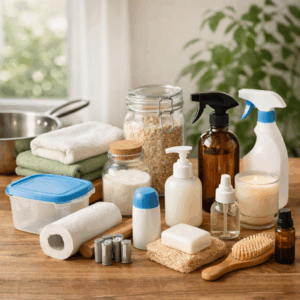
Concerns about chemical exposure are not limited to personal-care products. Many everyday household items contribute to cumulative exposure in ways most consumers rarely consider. Understanding where those exposures originate allows people to make more informed decisions about what they bring into their homes.
Several years ago, an article by Dr. Aly Cohen highlighted common household items that may warrant a second look. Rather than republishing that list uncritically, we’ve revisited the topic with updated scientific context and practical alternatives, with the goal of helping you evaluate exposures clearly and calmly.
Below are 10 household exposure sources worth re-evaluating. You do not need to replace everything at once. A gradual “swap as you run out / swap as it wears out” approach is usually more realistic, more affordable, and more sustainable.
1) Plastic food containers
Plastic containers degrade over time, particularly when exposed to heat, repeated dishwashing, and physical wear. Certain plastics are manufactured using compounds such as bisphenols or phthalates, some of which have demonstrated endocrine-disrupting properties in laboratory and epidemiological research.1,2
While “BPA-free” labels are common, some substitutes (such as BPS and BPF) have shown endocrine activity in early research, meaning that a “free-from” claim does not automatically equal “risk-free.”3,4
Alternatives (practical and realistic): Use glass or stainless containers for hot foods and reheating. Keep plastics for dry storage only. Replace containers that are cloudy, scratched, or smell like plastic. If you need lightweight options, reserve plastic for cold foods and short storage.
2) Prepared foods in plastic containers
Heating food in plastic packaging increases the likelihood of chemical migration from the container into the food. This tends to be more relevant with higher heat, repeated use, and with fatty or acidic foods.
Alternatives: Transfer prepared foods to glass or ceramic before microwaving. If you must microwave in plastic, avoid high heat, avoid repeated reheating in the same container, and do not microwave containers that are scratched or warped. For takeout, consider transferring to a plate/bowl immediately rather than eating from the plastic.
3) Nonstick cookware (PFAS coatings)
Many nonstick cookware coatings fall within the broader PFAS chemical class (often called “forever chemicals” due to persistence). PFAS are widely used, long-lasting, and many are detectable in human blood worldwide.5
Some legacy manufacturing processes used PFOA (a long-chain PFAS), which has been linked in research on exposed populations to health concerns including certain cancers, immune effects, and thyroid effects. Even when specific chemicals are phased out, older cookware remains in use, and replacement chemistries can still raise valid questions.6
Alternatives: Stainless steel, cast iron, enameled cast iron, glass, and truly PFAS-free ceramic options. If you cannot replace everything now, prioritize replacing older, scratched, or heavily worn nonstick pans first. For more detail, see our cookware deep dive: Hidden Dangers of Non-Stick Cookware.
4) Air fresheners and plug-in scents
Indoor air matters. The EPA notes that volatile organic compounds (VOCs) are emitted by a wide variety of household products and that indoor VOC concentrations can be significantly higher than outdoors.7 Scented products can emit numerous VOCs, including some classified as hazardous, even when marketed as “green.”8
Alternatives: Ventilation first (open windows when possible, run exhaust fans). Use baking soda for odor absorption and white vinegar for many odor-related cleaning tasks. If you want scent, consider “limited and intentional” approaches: a essential oil scented candle used occasionally in a well-ventilated room, simmer pots, or a small amount of essential oil in a diffuser used briefly (and discontinued if anyone gets headaches or irritation).
For more on ingredient disclosure and why “fragrance” often provides limited actionable information, see: How Many Ingredients Can Be Hidden Under the Word “Fragrance”?
5) Perfumes and heavily fragranced personal-care products
Fragrance formulas can include many components, often listed collectively as “fragrance” or “parfum.” The FDA explains that fragrance and flavor mixtures are the kinds of cosmetic components most likely to be treated as trade secrets, which limits ingredient-level disclosure to consumers.9
Alternatives: Choose fragrance-free or clearly disclosed essential oil scented products (recognizing that essential oils can still be irritating for some people). If you love perfume, consider reducing frequency, applying less, and avoiding spraying in enclosed spaces (cars, small bathrooms, offices).
6) Fabric and upholstery “protection” sprays
Stain- and water-resistance treatments have historically included fluorinated chemistry. Because of persistence concerns, many consumers now prefer to avoid routine application of chemical “coatings” in indoor living spaces, especially around children and pets.
Alternatives: Use washable covers, spot-clean when needed, and keep a basic “spill kit” (gentle soap, microfiber cloths, baking soda) rather than applying preventive coatings. If you do use a treatment, use it outdoors, allow full curing time, and ventilate thoroughly.
7) Cleaning products (especially fragranced and “antibacterial”)
Strong fragrances can contribute to indoor VOC exposure, and some “antibacterial” marketing has historically relied on active ingredients that did not demonstrate meaningful benefits over plain soap and water. The FDA issued a final rule that removed multiple antiseptic active ingredients (including triclosan) from consumer antiseptic wash products due to insufficient evidence of long-term safety and superior effectiveness for daily use.10
Alternatives: For everyday cleaning, start simple: unscented soap and water, diluted vinegar for many surfaces (avoid on natural stone), baking soda for gentle abrasion, and microfiber cloths. Reserve stronger disinfectants for situations where disinfection is actually needed (after illness, raw meat contamination, etc.) and ventilate while using them.
8) Cosmetics and personal-care products with limited disclosure
Many people use multiple personal-care products daily, which can mean repeated contact with preservatives, surfactants, and fragrance mixtures. While individual ingredients may be permitted under current regulations, some consumers prefer to reduce avoidable exposures by choosing products with full ingredient disclosure and fewer “catch-all” terms.
Preservatives Part I and Preservatives Part II.
9) Antiperspirants (and why people may choose deodorant instead)
Antiperspirants use aluminum salts to temporarily reduce sweating by forming a plug in sweat ducts. Aluminum is not an inert substance. It is a biologically active metal that can accumulate in the body, and it has demonstrated neurotoxic effects at elevated exposure levels. For decades, researchers have examined possible links between aluminum and neurodegenerative diseases such as Alzheimer’s. While the scientific community has not reached unanimous agreement on causation, the question has not been definitively closed either. Some studies suggest associations, others do not, and long-term low-level exposure remains an area of continued investigation. Because the data are not fully settled, some individuals choose to reduce aluminum exposure as a precautionary measure until more conclusive research clarifies its long-term neurological impact. There are also unsettled concerns about aluminum and breast cancer which circulate frequently.11,12
Alternatives: If you prefer to avoid aluminum exposure, choose deodorants (odor control) rather than antiperspirants (sweat reduction). Look for fragrance-free options if you are sensitive. Some people do well with magnesium-based deodorants; others tolerate baking soda poorly and may prefer formulas without it. If switching, expect an adjustment period.
10) Sunscreens with oxybenzone (and other chemical filters)
Chemical UV filters (including oxybenzone) have been studied for systemic absorption under maximal-use conditions. A JAMA study found that several sunscreen active ingredients can exceed the FDA’s plasma concentration threshold used to determine whether additional safety testing may be needed; this does not prove harm, but it supports the need for further evaluation and helps explain why some consumers prefer mineral sunscreens.13
Alternatives: Mineral sunscreens using zinc oxide. Also consider “non-product” sun protection strategies: hats, UV clothing, and shade planning. If you want a fuller breakdown of sunscreen ingredients, see: Do You Really Need a SunScreen?
A note on “natural” claims
The term “natural” is not tightly regulated in cosmetics. “Organic” has more formal standards, but certification can be expensive for small businesses and is not always practical for every ingredient. In most cases, the most useful indicators are transparency (full ingredient listing), clear sourcing, and a willingness to answer questions.
A realistic way to apply this list
You do not need to toss everything at once. Start with a single category that fits your life right now: (1) switch what you heat food in, (2) reduce routine indoor scenting, or (3) replace one worn nonstick pan. Small changes add up, especially when they reduce repeat exposures.
And don’t forget pets: their exposures are often closer to the floor and their bodies are smaller. Read ingredient labels on pet shampoos and sprays too. We’ve written more about that here: Why Your Pet Needs an All-Natural Soap Too.
Rob
References
1. US EPA. Phthalates. https://www.epa.gov/assessing-and-managing-chemicals-under-tsca/phthalates
2. US EPA. Biomonitoring – Phthalates (America’s Children and the Environment). https://www.epa.gov/americaschildrenenvironment/biomonitoring-phthalates
3. EFSA. Re-evaluation of BPA risks to public health (2023). https://efsa.onlinelibrary.wiley.com/doi/10.2903/j.efsa.2023.6857
4. NIEHS. Insight into endocrine disruptor bisphenol A. https://www.niehs.nih.gov/news/factor/2021/11/feature/2-feature-bpa-research
5. US EPA. PFAS Explained. https://www.epa.gov/pfas/pfas-explained
6. Rosato I, et al. Estimated half-lives of PFAS in humans (review). Environmental Research (2024). https://www.sciencedirect.com/science/article/pii/S0013935123025471
7. US EPA. Volatile Organic Compounds’ Impact on Indoor Air Quality. https://www.epa.gov/indoor-air-quality-iaq/volatile-organic-compounds-impact-indoor-air-quality
8. Potera C. Scented Products Emit a Bouquet of VOCs. Environmental Health Perspectives (2011). https://pmc.ncbi.nlm.nih.gov/articles/PMC3018511/
9. US FDA. Fragrances in Cosmetics. https://www.fda.gov/cosmetics/cosmetic-ingredients/fragrances-cosmetics
10. US FDA. Skip the Antibacterial Soap; Use Plain Soap and Water (consumer update). https://www.fda.gov/consumers/consumer-updates/skip-antibacterial-soap-use-plain-soap-and-water
11. National Cancer Institute. Antiperspirants/Deodorants and Breast Cancer. https://www.cancer.gov/about-cancer/causes-prevention/risk/myths/antiperspirants-fact-sheet
12. American Cancer Society. Antiperspirants and Breast Cancer Risk. https://www.cancer.org/cancer/risk-prevention/chemicals/antiperspirants-and-breast-cancer-risk.html
13. Matta MK, et al. Effect of Sunscreen Application Under Maximal Use Conditions on Plasma Concentration of Sunscreen Active Ingredients. JAMA (2019). https://jamanetwork.com/journals/jama/fullarticle/2733085
Nature's Complement is a participant in the Amazon Services LLC Associates Program, an affiliate advertising program. If you purchase products on Amazon through any of our affiliate links, we get a small percentage of the transaction, at no extra cost to you. We spend a lot of time writing the articles on this site, and all this information is provided free of charge. When you use our affiliate links, you support the writing you enjoy without necessarily buying our products. (However we would appreciate if you would do that too!) Thank you for helping to support our work, however you choose to do so.
These statements have not been evaluated by the Food and Drug Administration. This information and/or products are not intended to diagnose, treat, cure or prevent any disease.